

Specify jewelry box dimensions by function: outside dimensions for logistics, usable internal dimensions for fit, and insert dimensions for retention. Agree measurement points and tolerances with the manufacturer. A nominal box size does not tell you whether jewelry will fit safely.
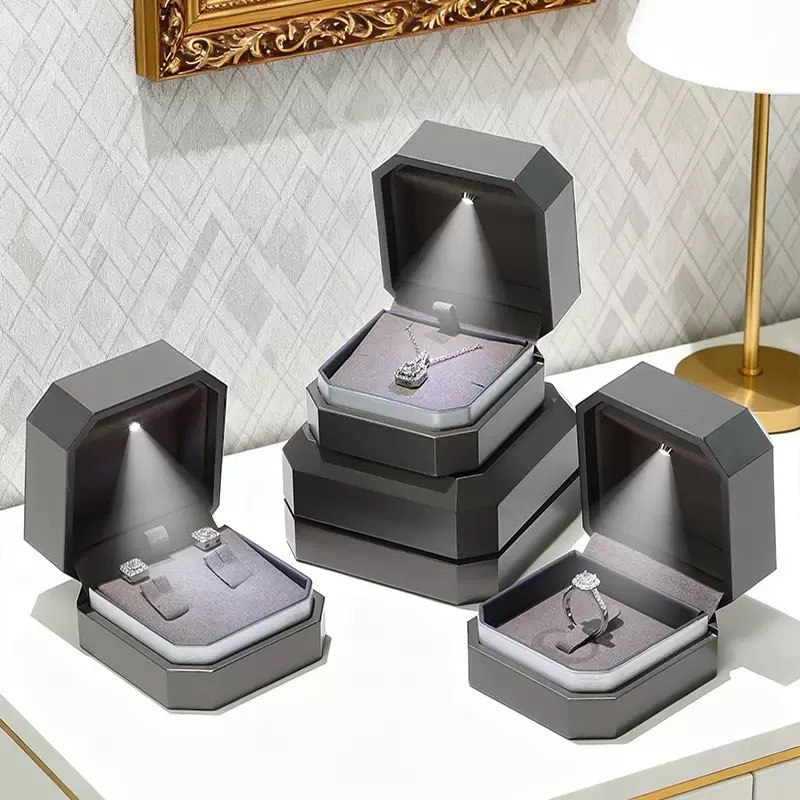
Gray faceted jewelry boxes with open lids and fitted supports.
Separate the three dimension systems
External length, width and height determine carton packing. Internal usable dimensions exclude walls, hinges and any space occupied by the insert. Insert dimensions include slots, holes and support height. Label each drawing clearly. Confusing outer height with clearance above a tall ring setting can create a box that looks correct on paper but presses against the jewelry.
Identify the critical measurements
Not every dimension needs the same precision. A necklace board must fit its cavity, a drawer needs sliding clearance and a lid must close without excessive force. Mark the dimensions that control those functions. Ask the manufacturer which tolerances its process can maintain and how material thickness or wrapping affects the finished result.
Include the complete tolerance stack
The jewelry, insert, lining and box each vary. Check the largest product with the smallest usable cavity and the thickest relevant lining condition. Avoid specifying zero clearance simply because a digital drawing permits it. Validate the assembled design using physical samples representing the planned materials.
Define how inspection will measure
Record the instrument, measurement position and whether the box is open, closed or assembled with its insert. Soft inserts can compress under a measuring tool, so the method matters. Use the same definitions during sampling and batch inspection. When a size changes, check its effect on carton volume and artwork placement as well as product fit.
Name the dimension that controls the function
A jewelry box drawing should distinguish external dimensions, internal usable space and insert dimensions. These measurements answer different questions. A wider external shell may provide no extra necklace space if the covering or internal structure changes. Identify the reference surfaces and measurement orientation for each critical dimension before comparing samples.
For external dimensions labeled, define the decision before collecting more samples. Identify who needs the result and what they can approve. In the review titled “Name the dimension that controls the function”, record the unresolved assumptions. For external dimensions labeled, ask which actual configuration the current evidence covers. Keep observations separate from preferences and proposed alternatives. If an answer remains incomplete, assign a follow up owner. Keep the agreed requirement for external dimensions labeled visible in the purchase record. Give the next reviewer enough context to reproduce the comparison. Do not rely on a verbal assurance alone.
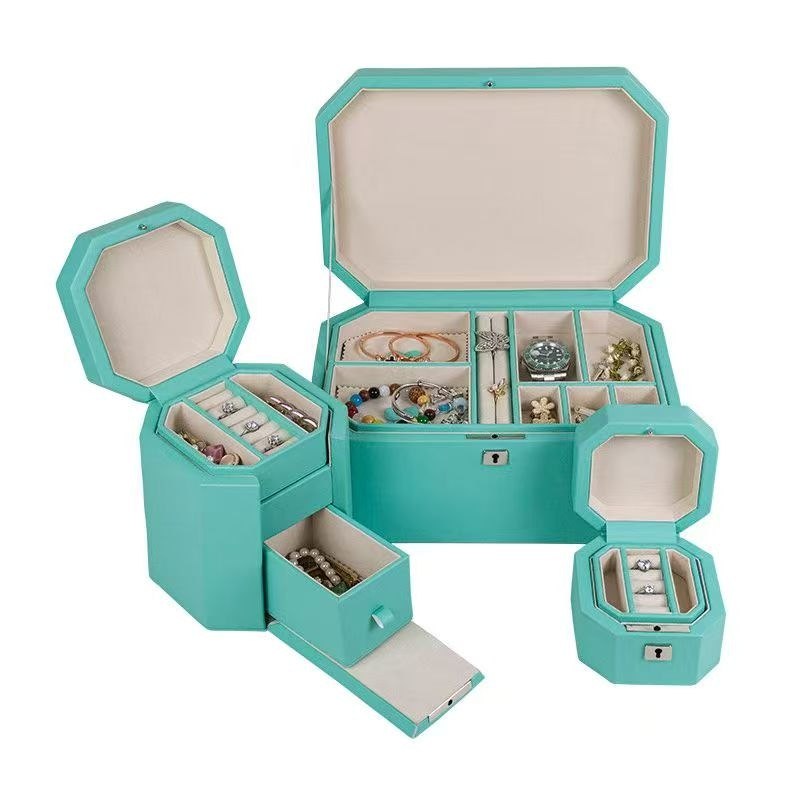
Turquoise jewelry organizer with several compartments and small cases.
Evaluate the complete stack of components
Board, wrapping, adhesive and insert thickness all contribute to the assembled fit. Ask which dimensions are controlled on separate components and which are verified after assembly. A component can meet its own drawing while the combined package becomes difficult to close. Review the interactions around the jewelry rather than treating every measurement independently.
Treat usable cavity dimensions labeled as a named requirement in the comparison record. Show the current reference beside the proposed alternative. For the issue addressed in “Evaluate the complete stack of components”, change one relevant variable at a time. Record the product or component actually used in each comparison. Keep the original observations available after choosing a preferred option. Otherwise, a later purchaser may repeat an already rejected approach. Ask whether a change to usable cavity dimensions labeled affects another requirement or packing task. Resolve that interaction before releasing the complete configuration. The aim is a decision others can follow without guesswork.
Agree how the measurement will be made
Record whether the lid is open or closed, whether the insert is installed and how compressible material is handled. A ruler reading on soft velvet can differ from a measurement of the supporting structure. Use equipment and technique appropriate to the feature. Photographs showing the reference points help make comparisons reproducible.
Assign responsibility for insert slot and support dimensions across the handover between teams. The person selecting an option may not perform the packing. Use “Agree how the measurement will be made” as a review topic for the people responsible for selection and packing. Record any preparation or special handling the approved result requires. If a workaround is necessary, evaluate whether it is repeatable. Avoid leaving essential technique in one experienced operator’s memory. Include insert slot and support dimensions in the practical handover instructions and first run review. When insert slot and support dimensions is questioned, compare the documented design with the packing method. Review the assembled result before closing the action.
Select limits from product needs
A decorative outer dimension may permit more variation than a cavity protecting a raised gemstone. Determine which functional failure occurs at each end of the proposed range. Ask for supplier input on what the intended construction can consistently achieve. Do not copy a tight numerical tolerance onto every dimension without considering its purpose and verification method.
Test the boundary combinations
Check samples representing the product and packaging combinations most likely to create interference or excessive movement. A large clasp in a small usable cavity is a different risk from a tiny pendant in a roomy recess. Record the combinations examined. A successful test with one average product should not be generalized to an entire collection.
Keep dimensional changes connected to approval
When a supplier proposes changing an insert or covering, review the measurements that depend on that component. Update drawings and fit records together. Retain the original definition of each measurement so the team can distinguish a real dimensional change from a change in measuring technique. Clear revision control prevents misleading comparisons during reorders.
Illustrative purchasing scenario
Imagine an illustrative ring box whose shell and insert each match their separate component drawings, yet the installed ring sits too high. The buyer initially requests a larger external box. A closer review shows that the finished insert thickness, covering and slot depth were never defined as an assembled fit requirement.
The team agrees how usable cavity height and seated ring height will be measured. It records the reference surfaces and the intended ring position. The supplier then compares the actual assembled dimensions, rather than repeating nominal board measurements that do not explain the interference.
Several ring profiles are checked. A tall setting challenges lid clearance, while a thicker band challenges the slot. The preferred correction changes the insert construction without automatically changing the shell. Reviewers confirm that the ring remains stable and easy to remove after the change.
The updated approval links the shell, finished insert and product range. Critical dimensions receive limits based on their function and the proposed manufacturing capability, with the measurement method documented. This is an illustrative problem solving sequence, not a recommendation for a universal numerical tolerance. It shows why dimensions need definitions and relationships. A collection of precise looking numbers can still fail to control the package when none describes the assembled condition that matters to the jewelry.
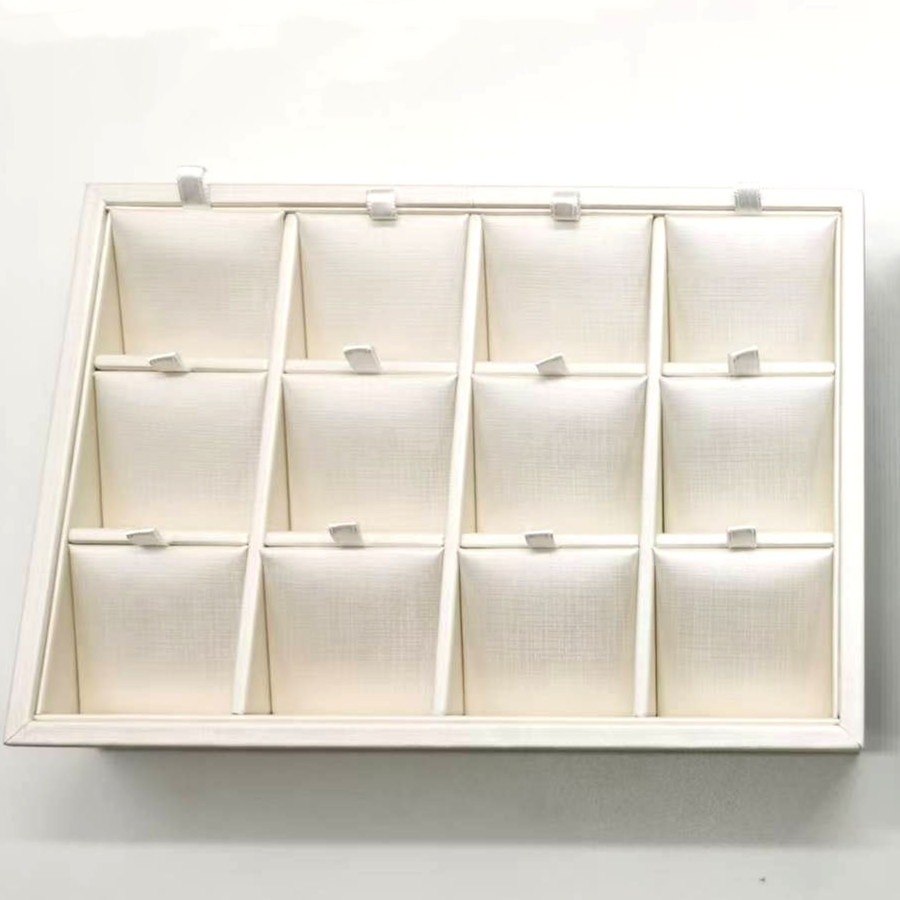
White rectangular tray divided into eight padded compartments.
Buyer checklist
- · External dimensions labeled
- · Usable cavity dimensions labeled
- · Insert slot and support dimensions
- · Critical tolerance stack
- · Measurement method agreed
- · Worst case product sample tested
Practical example
A ring may fit the footprint but fail the height check. Specify clearance from the insert support surface to the closed lid interior, including the highest stone setting. Confirm the required gap with an assembled sample rather than assuming a universal allowance.
Frequently asked questions
What tolerance should every jewelry box use?
There is no single suitable value. It depends on material, construction, manufacturing process and the function being controlled.
Can I measure only the empty shell?
No. Inserts, lining and closures can reduce usable space. Measure and test the assembled packaging.
Discuss your packaging specification
Send a dimensioned jewelry drawing and the intended display position so OnTheWay Packaging can review the cavity, insert and lid clearance together.
Explore Custom Jewelry Packaging Design or contact OnTheWay Packaging.


.png)
.png)
.png)

.png)

.png)