

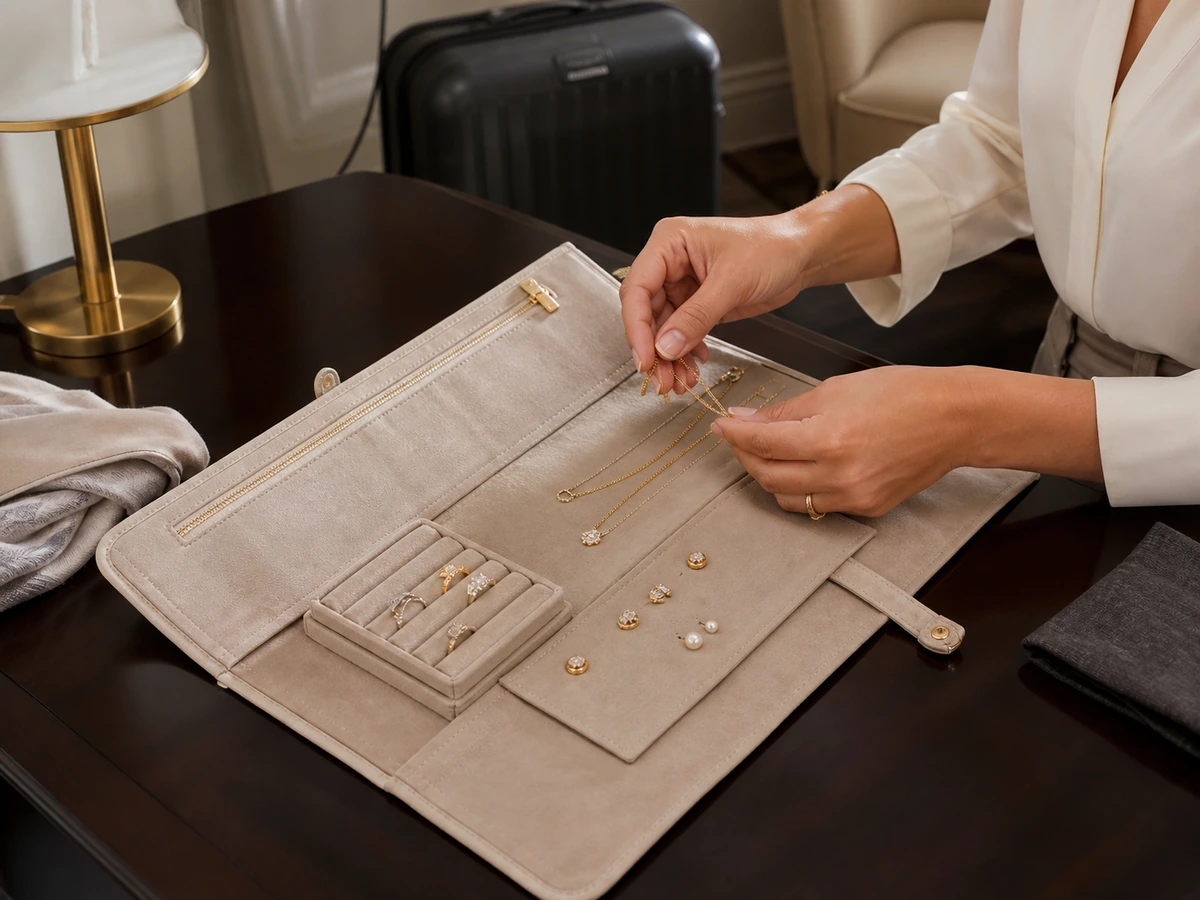
A jewelry roll should organize pieces without letting chains tangle, earrings migrate, or hardware scratch polished surfaces. Choose the internal layout before selecting the exterior material. The best design opens clearly, closes without pressure points, fits the intended luggage or gift box, and remains practical after repeated travel use.
Formats and Structures Worth Comparing
Different formats solve different protection, display, storage, travel, and handling problems. Select a structure only after defining the exact jewelry and channel.
Flat tie roll
A flexible panel wraps around compartments and ties closed; it is lightweight but relies on disciplined folding.
Snap-closure roll
Snaps create a defined closed size and faster packing; hardware must be isolated.
Zippered travel roll
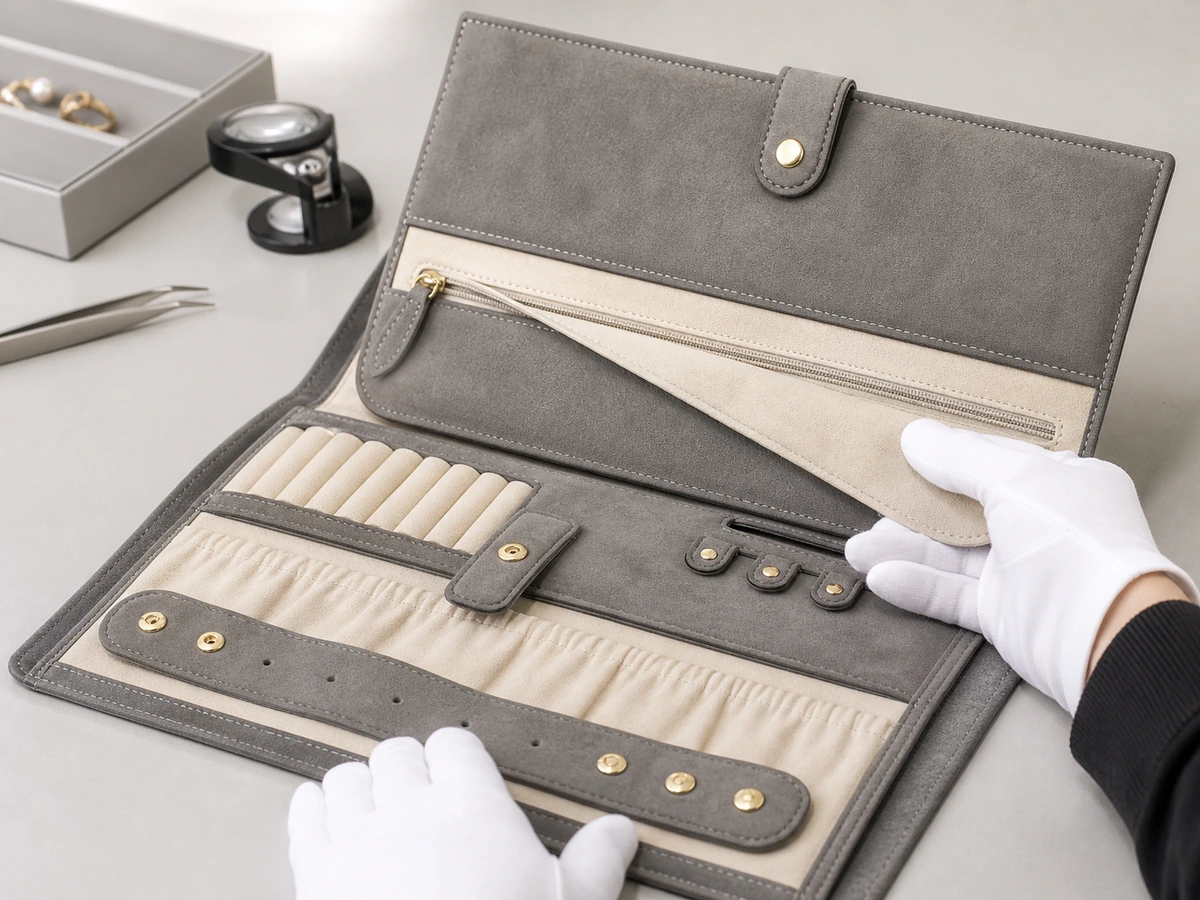
A perimeter zipper adds security, while zipper teeth and pullers require protective guards.
Detachable-pocket roll
Removable sections improve flexibility but increase component tracking and attachment testing.
Hybrid roll and pouch
Combines ring bars, earring panels, necklace tabs, and a small removable pouch for mixed collections.
Key Selection Factors
A reliable specification connects product geometry, daily handling, materials, visual presentation, and supply controls. Review these factors before decoration or price.
Compartment logic
Map rings, studs, hoops, pendants, chains, bracelets, and watches to separate, accessible retention features.
Anti-tangle control
Chains need anchors at more than one point, plus enough separation to stop crossing during rolling.
Fold pressure
Close the loaded roll and check whether hard jewelry presses against other pieces or leaves permanent marks.
Hardware isolation
Cover snaps, magnets, zippers, hooks, and rivets so jewelry cannot rub against them.
Travel volume
Balance capacity with a predictable closed footprint that fits the buyer’s luggage, mailer, or gift set.
Buyer Comparison Framework
Use the same evidence for every concept so appearance does not hide operational weaknesses.
|
Decision area |
What to verify |
Approval evidence |
|
Compartment logic |
Map rings, studs, hoops, pendants, chains, bracelets, and watches to separate, accessible retention features. |
Written specification plus physical sample and agreed inspection point |
|
Anti-tangle control |
Chains need anchors at more than one point, plus enough separation to stop crossing during rolling. |
Written specification plus physical sample and agreed inspection point |
|
Fold pressure |
Close the loaded roll and check whether hard jewelry presses against other pieces or leaves permanent marks. |
Written specification plus physical sample and agreed inspection point |
|
Hardware isolation |
Cover snaps, magnets, zippers, hooks, and rivets so jewelry cannot rub against them. |
Written specification plus physical sample and agreed inspection point |
|
Travel volume |
Balance capacity with a predictable closed footprint that fits the buyer’s luggage, mailer, or gift set. |
Written specification plus physical sample and agreed inspection point |
Step-by-Step Selection Process
Move from use requirements to structure, then materials and decoration. Each stage should close a specific risk before production.
1. Build a jewelry inventory map for the intended user.
2. Create a flat internal layout before styling the exterior.
3. Load a structural prototype with real jewelry and close it.
4. Run shake, drop-in-bag, opening-cycle, and tangle checks.
5. Review seams, edge binding, magnets, snaps, and zipper guards.
6. Approve the final loaded sample, carton fold, and inspection points.
Sample and Quality Checklist
Evaluate the product in its loaded, handled, stored, and shipped condition. Record results instead of accepting broad descriptions such as “premium quality.”
- · Dimensions and usable space match the approved specification
- · Jewelry remains secure and can be removed without damage
- · Edges, seams, hardware, surfaces, and closures are clean and safe
- · Color, texture, and logo match the approved physical reference
- · The product performs under realistic handling and storage
- · Unit packing and master cartons prevent rubbing and deformation
Common Mistakes to Avoid
Most failures originate in an incomplete brief or an empty sample that never meets the real jewelry and workflow.
- · Adding many pockets without a clear packing sequence
- · Allowing necklaces to cross when the roll closes
- · Placing rings or stones under snap pressure
- · Choosing decorative fabric that attracts lint or transfers color
- · Testing the roll empty instead of fully loaded
What to Include in Your RFQ
A complete RFQ produces comparable answers and fewer revisions. Attach drawings where useful, and identify mandatory details.
- · Exact product type, dimensions, weight, quantity, and use case
- · Structure, usable dimensions, materials, colors, and contact surfaces
- · Closures, hardware, inserts, compartments, and accessories
- · Logo artwork, position, finish, and acceptable appearance
- · Quantity by version, unit packing, carton packing, and destination
- · Sample stages, approval date, inspection method, and required documents
Frequently Asked Questions
These answers support early sourcing decisions. Final requirements should be confirmed with actual products and a production-intent sample.
How many compartments should a jewelry roll have?
Use only the compartments needed for the intended jewelry mix. More pockets can add bulk and confusion if they do not solve a specific retention problem.
Are magnets safe for every jewelry roll?
Magnets may be suitable in some closures, but they must be isolated and assessed for the product, accessories, and user context. Do not assume universal compatibility.
What is the most important travel test?
Load the exact jewelry mix, close the roll, carry it inside the intended bag, then check tangling, migration, pressure marks, closure security, and ease of repacking.
Can one roll support retail and gifting?
Yes, when the exterior presentation, labeling, gift box, and internal layout are designed as one system rather than separate items.
Approve the Complete Product, Not a Catalog Image
The best choice is the one that works with the exact jewelry, user journey, handling environment, and brand system. Define the specification, test a production-intent sample, and preserve a physical approval reference. OnTheWay offers custom jewelry packaging and display categories that buyers can evaluate against a written brief.


.png)
.png)
.png)

.png)

.png)