

How to Choose Watch Boxes for Packaging, Storage, or Travel
Choose a watch box by defining its job before selecting a material. A single-watch retail box must present the watch, protect it in distribution, and carry brand information. A multi-watch collector box must manage spacing, repeated access, and different wrist sizes. A travel case prioritizes compact restraint, while a winder adds mechanical and electrical requirements beyond ordinary packaging.
After choosing the use case, measure the complete watch, test the cushion with the closed strap, check clearance around the crystal and crown, and review the box while fully loaded. The right box is not simply large enough; it keeps the watch centred without forcing the strap or allowing hard parts to collide.
Choose the Job Before You Choose the Box
Watch boxes sold under the same name can solve very different problems. Write one sentence describing when the customer receives, opens, carries, stores, or displays the watch. That sentence determines the opening style, insert, closure, accessory space, and durability level more reliably than a mood board alone.
|
Use case |
Primary design question |
Typical structure direction |
|
Single-watch retail presentation |
How should the watch appear at first opening and survive distribution? |
Hinged or lift-off presentation box with fitted cushion and outer protection |
|
Multi-watch storage |
How can different case and wrist sizes remain separated during repeated use? |
Compartments with removable pillows, dividers and clear access |
|
Travel |
How can the watch be restrained in a compact form? |
Roll, zip case or compact holder with soft partitions and secure closure |
|
Winder |
What mechanism, power, noise and watch orientation are required? |
Engineered enclosure designed around a validated winder module |
Measure the Complete Watch, Not Only the Case Diameter
Case diameter is only one input. Record total case thickness, crystal profile, crown and pusher projection, lug-to-lug length, strap or bracelet width, closed-loop circumference, clasp thickness, and any rigid bracelet section. Also identify the heaviest and smallest watches expected to use the same box. These extremes reveal whether one cushion can serve the range.
|
Measurement |
Why it matters |
|
Case diameter and thickness |
Controls visible scale, recess size and lid clearance |
|
Lug-to-lug length |
Affects how the watch sits on a pillow and whether lugs overhang |
|
Crown and pushers |
Require side clearance and protection from compartment walls |
|
Closed strap circumference |
Determines cushion compression and whether the clasp is forced |
|
Clasp thickness and position |
Can raise the watch, create pressure points or contact the base |
|
Total weight |
Influences insert retention, box stability and transit movement |
Fit the Cushion to the Strap Geometry
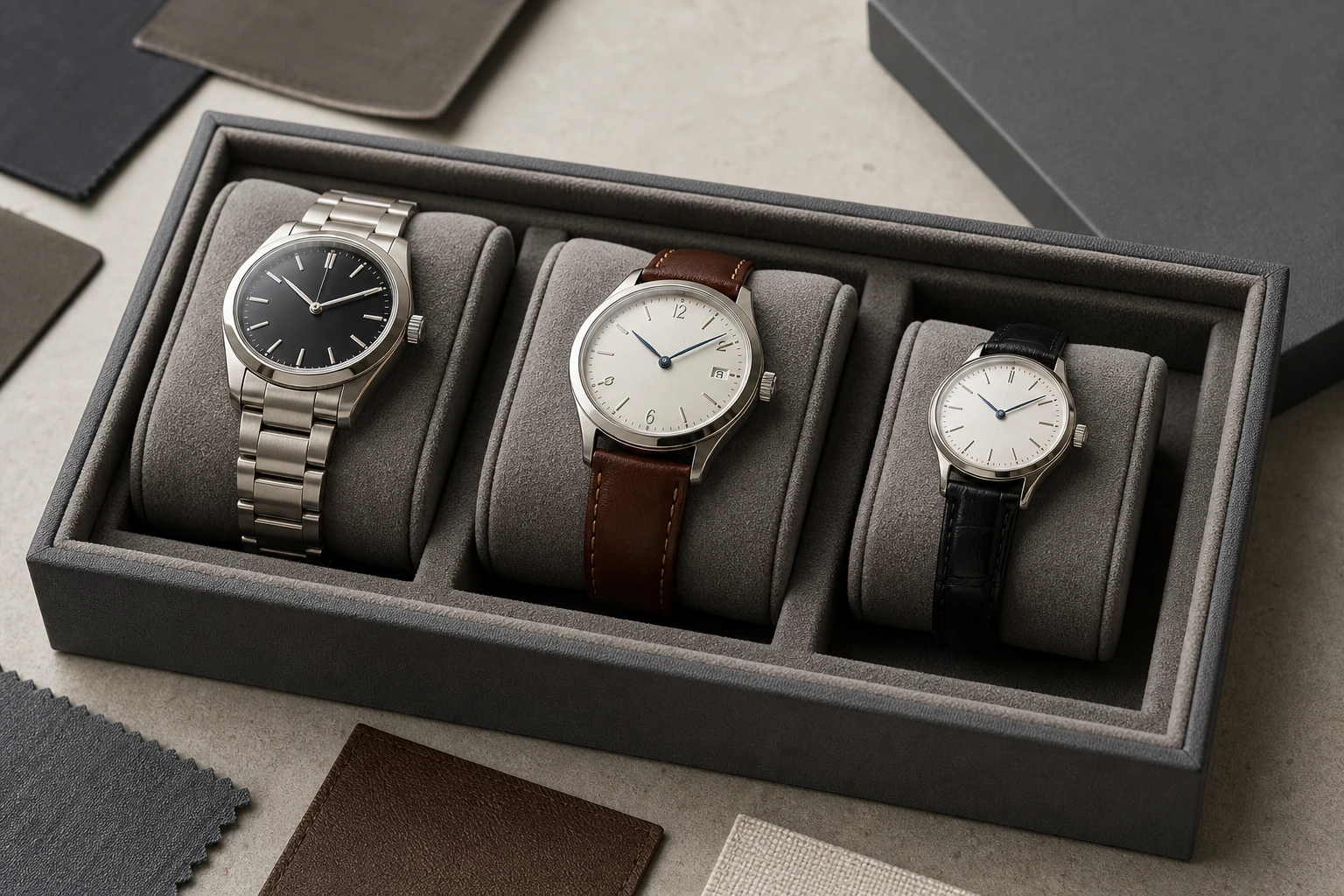
A cushion should support the watch without becoming a stretching tool. Test it with a closed metal bracelet, a short leather strap, and the smallest intended circumference. Compressible side wings or removable cores can accommodate a wider range than a rigid oversized pillow. The seam, zipper, snap, or fastening point should not sit beneath the case or clasp.
For multi-watch boxes, check whether each pillow can be removed without scraping the neighbouring watch. A small finger gap may improve handling, but too much clearance allows the watch to rotate. Review the loaded compartment from the side as well as the top to see where the case, crown, and clasp actually sit.
Protect the Crystal, Crown, and Clasp When the Lid Closes
A box can look correct when open and fail when closed. Use removable witness material or another non-marking clearance method to confirm that the lid lining, accessory flap, or upper cushion does not press the crystal. Check crown and pusher clearance against side walls. Shake and orientation tests should not allow a hard clasp to strike the case or another watch.
- · Close the box with the tallest intended watch.
- · Check lid lining and accessory pockets for crystal contact.
- · Turn the loaded box through expected shipping orientations.
- · Confirm that the pillow cannot lift out unintentionally.
- · Inspect clasp, case back, crown and lugs after the test.
Pair the Exterior and Interior With the Ownership Experience
Paper-wrapped rigid board supports branded retail packaging and efficient graphic finishing. Wood creates a substantial collector presentation but makes joinery, weight, and surface consistency important. Leatherette can deliver a tactile exterior across presentation or storage formats, while metal accents add definition but require careful isolation from the watch. Inside, microfiber, suede-like fabric, velvet, or smooth textile should be reviewed for colour transfer, lint, seam placement, and abrasion.
|
Direction |
Best evaluated for |
Watch-specific caution |
|
Paper-wrapped rigid box |
Retail launch, gifting and printed brand systems |
Protect corners and ensure the insert remains secure after distribution |
|
Wood or wood-finished box |
Collector storage and high-touch presentation |
Check lid alignment, hinge action, weight and finish around edges |
|
Leatherette-covered box |
Tactile presentation and coordinated storage |
Inspect wrapped corners, seam locations and surface marking |
|
Metal-accented structure |
Architectural premium detail |
Keep hardware and trim away from the crystal, case and bracelet |
Design a Place for Every Part of the Watch Story
Warranty cards, manuals, hangtags, spare links, charging cables, tools, and cleaning cloths should not be added after the box is designed. Map each item by size, thickness, access order, and risk of contact with the watch. A paper pocket may suit flat documents, while metal links or tools need a restrained compartment. Keep printed information readable without making the customer remove the watch first.
The external sleeve, shipper, and retail box should also work as a system. If the presentation box is intended for long-term storage, avoid labels or closures that damage its finish during opening. Confirm barcode and regulatory information locations with the destination-market team rather than placing them by visual preference alone.
Run Transit Checks With the Watch Fully Loaded
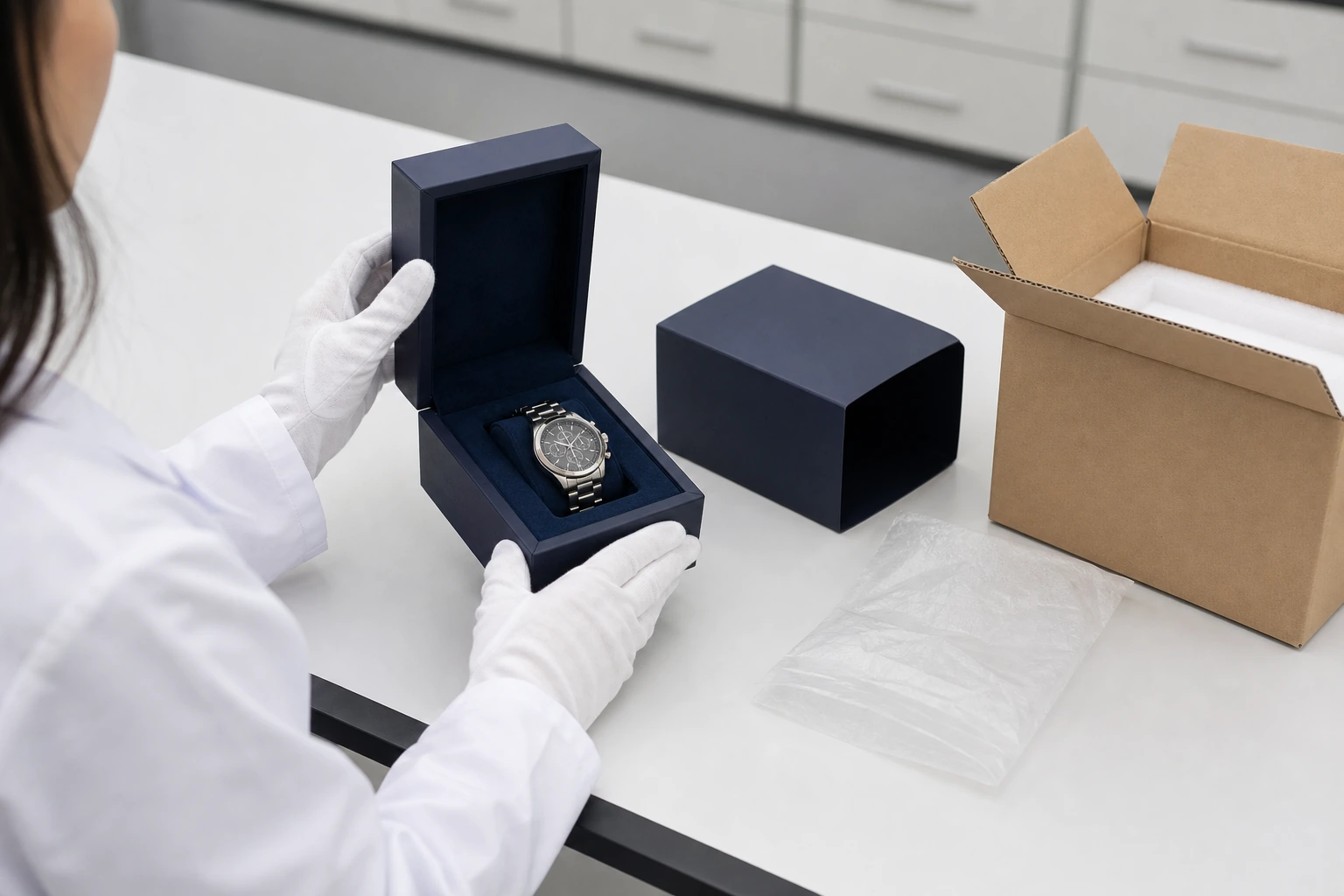
An empty-box drop test cannot reveal how a heavy watch interacts with the insert. Use representative watches or dimensionally accurate dummies and pack the complete system, including sleeve, retail box, protective bag, and shipper. After the chosen distribution test, inspect centring, pillow retention, lining marks, crystal contact, closure alignment, corner damage, and accessory movement.
The test plan should reflect the actual route and handling method. Record the sample version and loading configuration so a later result can be compared with the approved condition. If the watch is shipped separately from the box, create a different test that reflects that workflow.
Control the Details Buyers Notice at Every Opening
Watch boxes are handled repeatedly, so small inconsistencies become visible. Establish approved references for exterior colour, lining tone, logo position, gap symmetry, hinge resistance, closure feel, insert height, pillow compression, and accessory placement. The inspection method should state how each feature is judged and which reference controls the decision.
- · Loaded watch remains centred and does not rotate
- · Pillow supports the smallest and largest intended strap loops
- · No hard component can contact the crystal, crown, case or bracelet
- · Lid, hinge and closure operate without rubbing or sudden release
- · Logo, seams and compartment lines remain visually aligned
- · All accessories are restrained in their assigned positions
Watch Box Questions Buyers Should Resolve Early
Can one pillow fit both metal bracelets and leather straps?
Sometimes, but it must be tested across the smallest and largest closed circumferences. A compressible or adjustable pillow may cover a broader range than a rigid one.
Is a glass lid suitable for shipping a watch?
A transparent lid can support display, but its material, retention, protection, and packing must be engineered for the route. Do not assume a display lid is automatically distribution-ready.
Should a retail watch box also serve as long-term storage?
It can, if the structure, hinge, lining, and insert are designed for repeated use. Define this requirement before sampling because it changes durability expectations.
What should I send for a quotation?
Provide the watch use case, complete dimensions, representative watch images, cushion range, accessory list, box style, brand artwork, material direction, quantity, destination, and packing requirements.
Send a Watch Specification, Not Just a Box Reference
A clear inquiry identifies the box’s job, the watches it must fit, the unboxing sequence, required accessories, preferred materials, brand controls, and distribution route. Share the smallest and largest representative watches and mark any feature that cannot change. This allows a supplier to review cushion geometry, clearance, structure, finish, and packing as one system.


.png)
.png)
.png)

.png)

.png)