

Top Jewelry Display Stand Manufacturers to Review for Custom Retail Projects
The best jewelry display stand manufacturer depends on what you are building. A brand ordering individual acrylic holders has a different project from a retailer developing a coordinated counter collection in wood, metal, fabric, and leatherette. This non-ranked shortlist focuses on companies whose official websites show relevant jewelry display products or custom display capabilities. It excludes general store-cabinet suppliers unless countertop jewelry presentation is clearly part of their offer.
Use the list as a research starting point, not a substitute for due diligence. Product images and marketing claims do not confirm that every process is completed in-house. Ask each candidate for a project-specific proposal, sample, material references, quality checkpoints, and packing plan before selecting a partner.
Which Manufacturer Type Matches Your Display Program?
A useful shortlist begins with the operating model of the project. Identify whether you need repeatable components, a complete visual merchandising system, or a bespoke presentation for a launch. The same supplier may serve more than one category, but the evidence you request should reflect the work you actually need.
|
Project archetype |
Typical scope |
Evidence to request |
|
Component-led acrylic program |
Ring blocks, earring stands, bracelet bars, necklace holders |
Edge quality, bonding, colour consistency, protective packing |
|
Coordinated counter collection |
Busts, trays, risers, holders and logo pieces in one visual language |
Set map, material swatches, loaded prototype and component codes |
|
Mixed-material luxury display |
Wood, metal, acrylic and soft coverings in one project |
Subcontractor disclosure, joint details, finish samples and packing tests |
|
Fast-changing retail campaign |
Modular pieces reused across launches |
Replacement parts, reconfiguration plan and repeat-order controls |
Manufacturers to Review for Focused Stands and Acrylic Components
The following companies present individual jewelry stands or component-led display ranges on their official sites. They may be useful when the brief is centred on a defined holder type rather than a full boutique environment. Confirm material grade, contact surfaces, edge treatment, branding method, and whether the quoted scope includes individual protective packing.
Sunday Knight Jewelry Display
Sunday Knight presents itself as a Dongguan manufacturer focused on custom jewelry display stands and props. Its product navigation covers bracelet, earring, necklace, ring, and watch displays, with a strong emphasis on acrylic. It is a relevant candidate for buyers who already know the component format they need and want to adapt size, colour, or branding. Before ordering, compare an approved physical sample with the production control method for polished edges, joints, slots, and surface protection.
SAMTOP Display
SAMTOP’s jewelry display offering sits within a broader custom retail-display business. The company shows stands, holders, window concepts, and showcase-related presentation work. This wider scope may suit agencies or brands that want jewelry supports to connect with other retail elements. Buyers should clarify which materials and fabrication steps are handled by the quoted facility, who owns engineering decisions, and how delicate finishes will be packed.
FANXI
FANXI markets jewelry display and packaging solutions, including display systems for multiple jewelry categories. It can be considered by buyers who want stands to coordinate with trays or packaging. Request a component-level proposal rather than relying on a broad catalogue: identify the exact jewelry dimensions, required contact materials, colour standard, logo process, and replacement needs.
Partners to Review for Coordinated Display Collections
A complete display collection requires more than manufacturing isolated pieces. The supplier must translate a brand language across different support geometries while keeping dimensions, colours, materials, and packing references controlled. These candidates show broader coordinated-display capabilities on their official sites.
OnTheWay Jewelry Packaging
OnTheWay’s display-stand category includes ring, earring, necklace, bracelet, watch, metal, wood, microfiber, and coordinated display-set directions. It is relevant for jewelry brands that want to discuss stands alongside trays, boxes, or other presentation assets. Buyers should send a counter plan and jewelry measurements, then confirm the exact materials, prototype boundaries, component quantities, and quality criteria for the proposed set rather than assuming every catalogue style shares the same construction.
DNY Display
DNY positions its jewelry work as custom-made display solutions, including complete sets, trays, showcase props, ring and necklace displays, bracelet supports, earring stands, risers, and logo blocks. This breadth makes it a candidate for brand-specific counter systems and mixed-material projects. Ask for a set map, drawings, finish references, and a loaded prototype plan so individual pieces are evaluated as one presentation system.
Lussopack
Thailand-based Lussopack presents luxury packaging and jewelry display collections, including ring stands, necklace forms, bracelet holders, trays, and coordinated sets. It may suit brands that want the display language to connect with premium packaging. Verify the exact production route, material specifications, sample approval process, and consistency controls that apply to the selected design.
Alex Velvet USA
Alex Velvet USA focuses on jewelry displays and related presentation products, with custom options and a long-standing velvet-display identity. It is worth reviewing for buyers whose assortment depends on soft-covered forms, trays, and traditional jewelry presentation. Confirm the origin of the proposed goods, colour and pile-direction controls, cleanability, logo execution, and how covered surfaces are protected in transit.
Compare the Service Model, Not Only the Address
A nearby sales office can simplify communication, while a specialist production partner may offer deeper process knowledge. Neither automatically produces a better result. Ask who prepares drawings, who approves materials, where each process occurs, who owns the sample, and who resolves deviations. For mixed-material displays, the coordination of acrylic, metal, wood, coatings, and soft coverings is often more important than a single country label.
Also distinguish stocked products from custom development. Stock can support quick replenishment but may limit proportions and brand control. Custom work offers more design freedom but requires clearer specifications and approval records. Choose the model that fits the expected life of the display and the number of locations it must serve.
A Practical Comparison Matrix for Your Shortlist
Send the same questions to every candidate and record the evidence returned. A polished proposal is useful, but an approved material sample, dimensioned drawing, loaded prototype, inspection record, and packing example are more actionable. The matrix below is designed for comparison without inventing a universal score.
|
Comparison area |
What to ask |
Acceptable evidence |
|
Product fit |
Which jewelry types and display formats are routinely developed? |
Relevant current projects or samples with sensitive client details removed |
|
Engineering |
Who confirms geometry, stability and contact points? |
Dimensioned drawing, tolerances where relevant, and prototype review notes |
|
Finish control |
How are colour, sheen, texture and logos approved? |
Physical swatches and signed finish reference |
|
Quality review |
Which features are inspected before packing? |
Project-specific checklist and defect examples |
|
Packing |
How are soft surfaces, edges and protrusions separated? |
Packing diagram or packed-sample review |
|
Repeat orders |
How are components and revisions identified? |
Part codes, revision control and retained approval references |
Give Every Candidate the Same Prototype Brief
Include the counter footprint, viewing direction, jewelry categories, representative product dimensions, target component list, brand palette, logo artwork, reference mood, destination market, and packing expectations. Mark fixed requirements separately from areas where alternatives are welcome. Ask each supplier to identify assumptions and exclusions in writing. This makes quotations easier to compare and prevents a lower price from hiding a reduced scope.
- · One plan view showing counter dimensions and restricted zones
- · Photographs or measurements of representative jewelry
- · Component schedule with intended quantity per store
- · Colour and material references on the intended substrate
- · Logo artwork and acceptable application methods
- · Prototype deliverables, approval stages, and required packing review
Approve Evidence, Not Just a Beauty Photograph
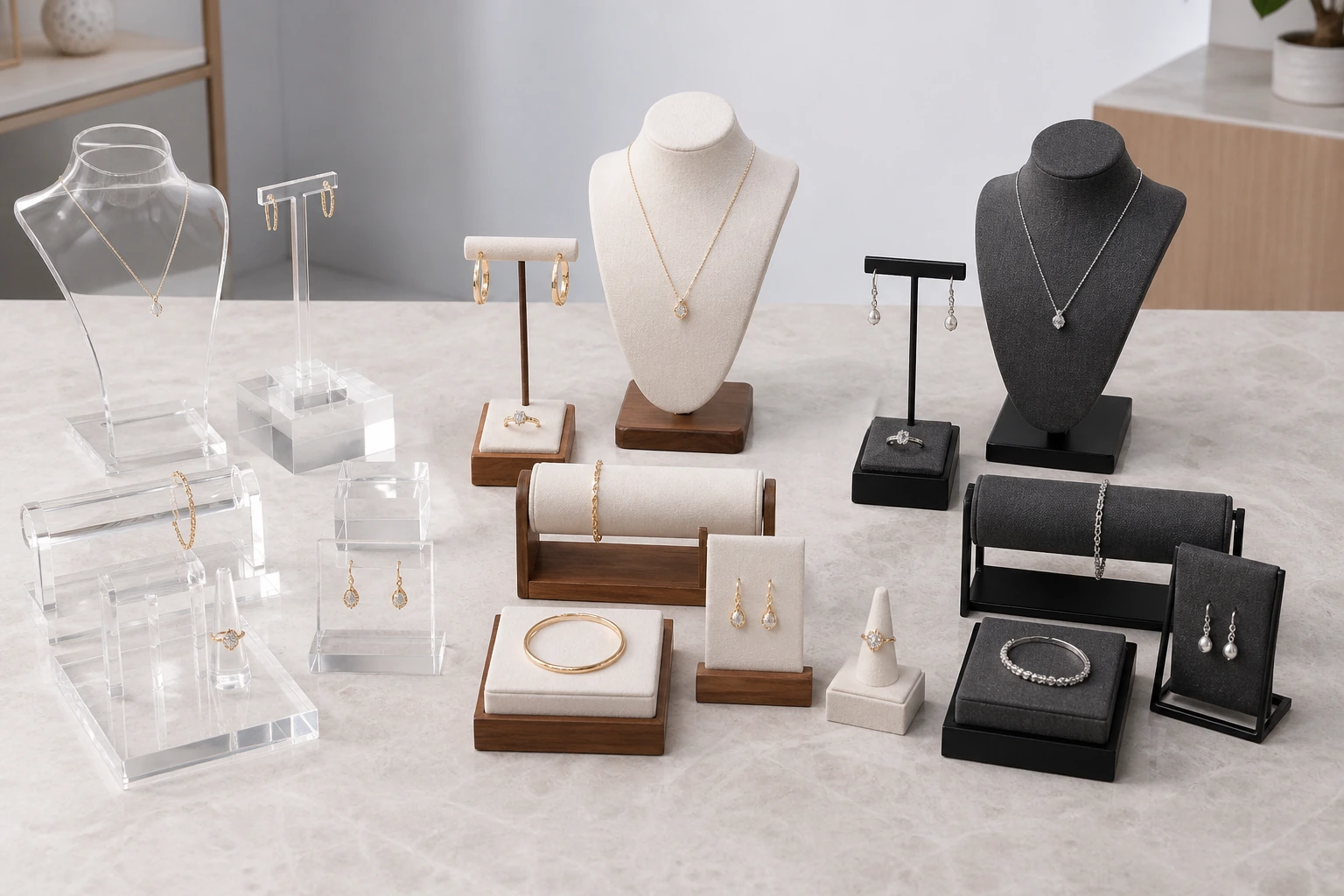
A front-view image does not prove that a display is stable, easy to handle, or safely packed. Ask for views of the rear, base, joints, contact pads, logo, and packed condition. Test the prototype with real jewelry under the intended lighting. Record changes on the drawing or specification rather than in scattered messages. For production, agree which features will be checked and how a deviation will be reported before shipment.
|
Approval stage |
Decision record |
|
Material direction |
Named substrate, surface, colour reference and contact material |
|
Structure |
Dimensions, support points, access, stability and component interfaces |
|
Branding |
Artwork version, size, position, colour and application method |
|
Loaded prototype |
Photographs and observations using representative jewelry |
|
Packing |
Protection sequence, component code and carton arrangement |
|
Production review |
Inspection points, approved references and deviation process |
Questions to Resolve Before Selecting a Manufacturer
Is a jewelry display manufacturer the same as a store-fixture manufacturer?
Not always. Display-stand specialists focus on countertop supports and presentation components, while fixture companies may focus on cabinets and interiors. Confirm that the supplier has evidence for your exact scope.
Should I choose one supplier for boxes and displays?
A combined partner can improve visual coordination, but only if it has the required product and process capability. Compare the approval and quality plan for each category.
How can I compare custom quotes fairly?
Issue the same brief, separate included and excluded work, compare materials and packing, and request the same prototype evidence. Do not compare headline prices before the scope is aligned.
Does a large catalogue prove manufacturing capability?
No. A catalogue shows range, not necessarily process ownership or current production. Ask where the proposed item is made and request project-specific evidence.
Build a Shortlist Around Your Actual Counter
Select two or three candidates whose visible work matches your project archetype, then give them the same brief. Compare how clearly they handle support geometry, materials, finish approval, branding, prototype testing, repeat-order control, and packing. The right partner is the one that can convert your retail intent into verifiable specifications—not simply the company with the broadest gallery.


.png)
.png)
.png)

.png)

.png)