

Choose a jewelry pouch by starting with the jewelry surface, packed dimensions, sales channel, and customer use. A soft pouch can add protection and brand value, but fabric, lining, seams, closures, and decoration must work together. Test the real jewelry inside a production-intent sample before approving color, logo, or bulk production.
Formats and Structures Worth Comparing
Different formats solve different protection, display, storage, travel, and handling problems. Select a structure only after defining the exact jewelry and channel.
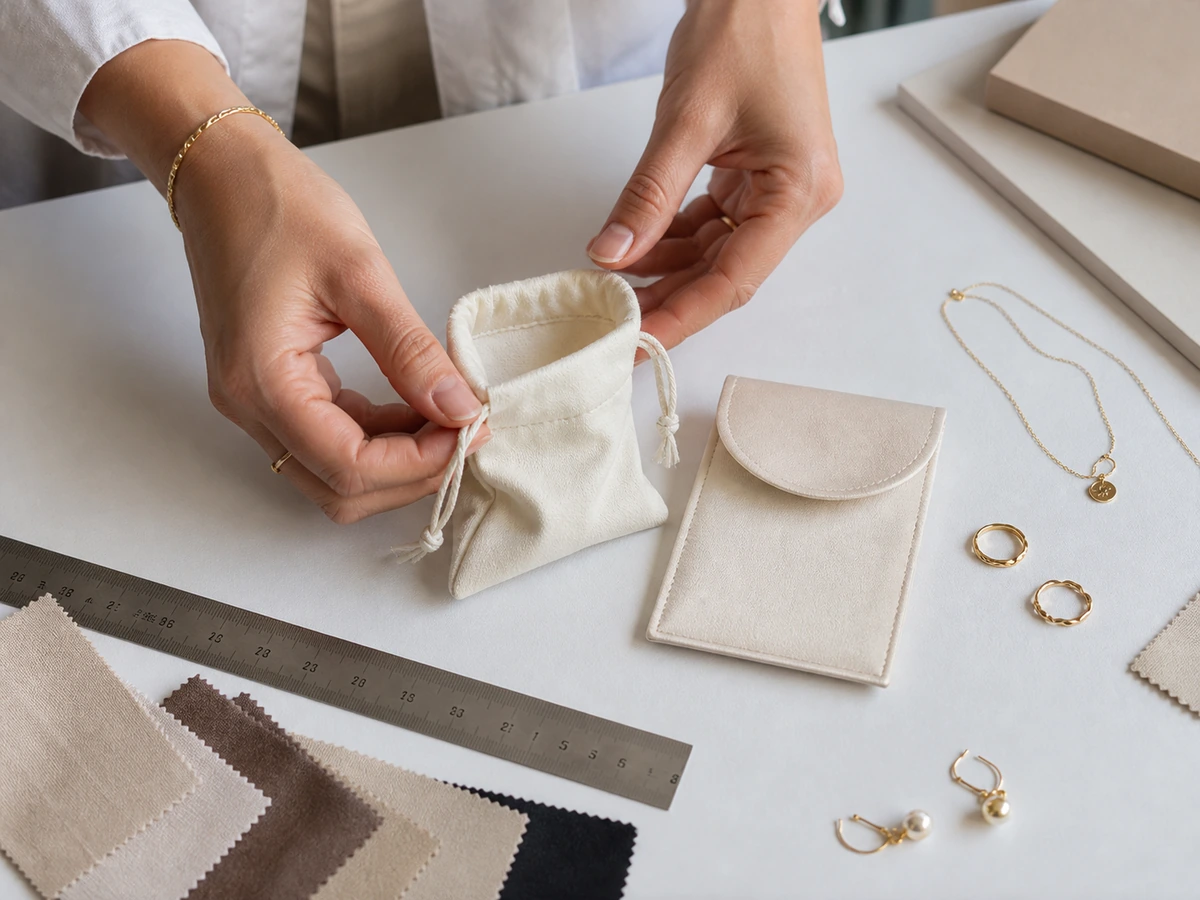
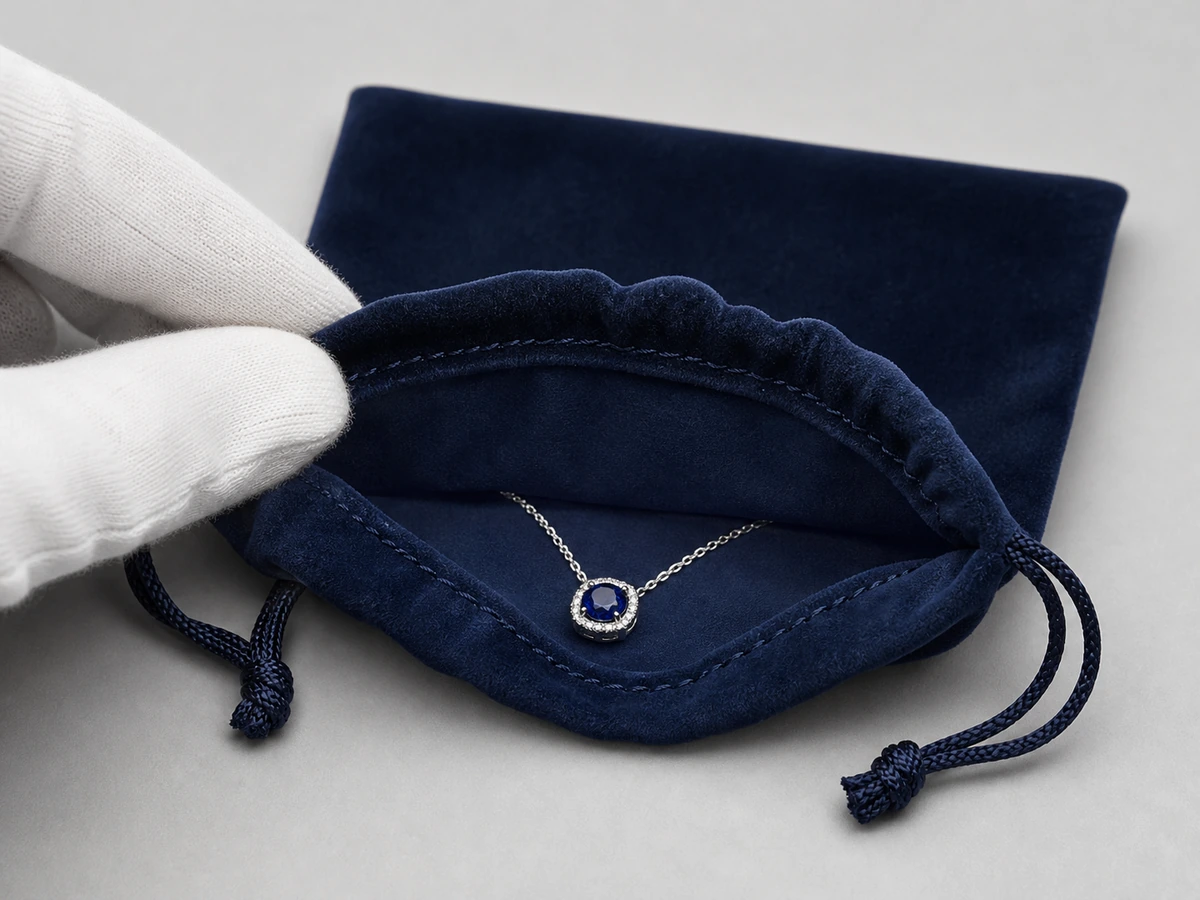
Drawstring pouch
Simple, familiar, and adaptable, but cord ends and channel stitching must be checked for snagging.
Envelope pouch
A fold-over flap creates a clean presentation and can reduce loose hardware near delicate jewelry.
Snap or magnetic pouch
A defined closure supports repeated use; confirm component position and jewelry clearance.
Zipper pouch
Useful for travel and retail sets when the zipper is isolated from the jewelry.
Multi-pocket pouch
Separates several pieces, but adds sewing, labeling, and packing complexity.
Key Selection Factors
A reliable specification connects product geometry, daily handling, materials, visual presentation, and supply controls. Review these factors before decoration or price.
Fabric behavior
Compare velvet, microfiber, suede-like fabric, cotton, linen, satin, and leatherette for abrasion, lint, dye transfer, drape, and brand fit.
Jewelry compatibility
Keep chains, prongs, posts, stones, plating, and polished surfaces away from rough seams, exposed hardware, and unsuitable coatings.
Size and opening
Measure the jewelry in its packed form and check whether staff and customers can insert and remove it without force.
Closure security
Test whether the pouch stays closed during handling without compressing or tangling the item.
Brand application
Match foil, print, embroidery, woven labels, or debossing to the fabric and artwork detail.
Buyer Comparison Framework
Use the same evidence for every concept so appearance does not hide operational weaknesses.
|
Decision area |
What to verify |
Approval evidence |
|
Fabric behavior |
Compare velvet, microfiber, suede-like fabric, cotton, linen, satin, and leatherette for abrasion, lint, dye transfer, drape, and brand fit. |
Written specification plus physical sample and agreed inspection point |
|
Jewelry compatibility |
Keep chains, prongs, posts, stones, plating, and polished surfaces away from rough seams, exposed hardware, and unsuitable coatings. |
Written specification plus physical sample and agreed inspection point |
|
Size and opening |
Measure the jewelry in its packed form and check whether staff and customers can insert and remove it without force. |
Written specification plus physical sample and agreed inspection point |
|
Closure security |
Test whether the pouch stays closed during handling without compressing or tangling the item. |
Written specification plus physical sample and agreed inspection point |
|
Brand application |
Match foil, print, embroidery, woven labels, or debossing to the fabric and artwork detail. |
Written specification plus physical sample and agreed inspection point |
Step-by-Step Selection Process
Move from use requirements to structure, then materials and decoration. Each stage should close a specific risk before production.
1. Group jewelry SKUs by packed dimensions and surface sensitivity.
2. Select a pouch style and material for each genuine product group.
3. Request fabric swatches and an undecorated sewn sample.
4. Test jewelry insertion, closure, rubbing, lint, and color transfer.
5. Approve logo size, position, color, and production-intent sample.
6. Lock seam, lining, cord, packing, and inspection requirements.
Sample and Quality Checklist
Evaluate the product in its loaded, handled, stored, and shipped condition. Record results instead of accepting broad descriptions such as “premium quality.”
- · Dimensions and usable space match the approved specification
- · Jewelry remains secure and can be removed without damage
- · Edges, seams, hardware, surfaces, and closures are clean and safe
- · Color, texture, and logo match the approved physical reference
- · The product performs under realistic handling and storage
- · Unit packing and master cartons prevent rubbing and deformation
Common Mistakes to Avoid
Most failures originate in an incomplete brief or an empty sample that never meets the real jewelry and workflow.
- · Choosing fabric by appearance without testing jewelry contact
- · Using one pouch size for products that tangle or move differently
- · Placing hard cord ends or zipper parts against jewelry
- · Approving color on screen instead of a physical sample
- · Ignoring how pouches crease or rub in master cartons
What to Include in Your RFQ
A complete RFQ produces comparable answers and fewer revisions. Attach drawings where useful, and identify mandatory details.
- · Exact product type, dimensions, weight, quantity, and use case
- · Structure, usable dimensions, materials, colors, and contact surfaces
- · Closures, hardware, inserts, compartments, and accessories
- · Logo artwork, position, finish, and acceptable appearance
- · Quantity by version, unit packing, carton packing, and destination
- · Sample stages, approval date, inspection method, and required documents
relevant OnTheWay product category;custom jewelry packaging design;contact OnTheWay
Frequently Asked Questions
These answers support early sourcing decisions. Final requirements should be confirmed with actual products and a production-intent sample.
Which material is best for a jewelry pouch?
No single material is best. Microfiber and soft suede-like fabrics can support delicate presentation, velvet creates a plush look, cotton and linen suit natural positioning, and leatherette can add structure. Test the exact jewelry and finish.
Can a pouch replace a jewelry box?
Sometimes, especially for lightweight products, travel, secondary protection, or lower-volume retail. Higher-value or fragile pieces may still need a rigid box or protective mailer.
How should pouch size be specified?
State usable internal width and height, seam allowance, closure position, jewelry orientation, and any insert card or care card.
What should be inspected in production?
Check dimensions, fabric shade, pile direction, seams, loose threads, closure action, logo position, staining, odor, jewelry contact surfaces, and packing.
Approve the Complete Product, Not a Catalog Image
The best choice is the one that works with the exact jewelry, user journey, handling environment, and brand system. Define the specification, test a production-intent sample, and preserve a physical approval reference. OnTheWay offers custom jewelry packaging and display categories that buyers can evaluate against a written brief.


.png)
.png)
.png)

.png)

.png)